WALASSE TING 丁雄泉
|
||||||||||
|
WALASSE TING 丁雄泉 |
||||||||||
|
|
|
|||||||||
|
Walasse Ting |
|||||
|
丁雄泉 |
|||||
|
|
|||||
|
|
|||||
|
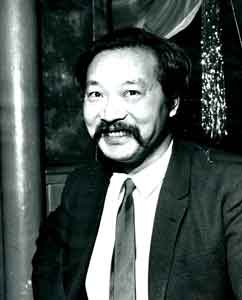
Born in China, Walasse Ting 丁雄泉 spent seven years in France, then went to the USA where he became an American national, before finally settling in Amsterdam.
China 1928 Ding Xiongquan was born on October 13, in continental China, in Wuxi
- a town 125 Km from Shanghai, near Suzhou - and spent his childhood in Shanghai. 1946 After reading Yi Jing, the book of changes, he was inspired to travel, leaving China for Hong Kong.
France 1950 He travelled to France on a liner, arriving with neither a passport nor a visa, and with only five American dollars He had his first encounter with western art (expressionism, and Picasso) and immediately began to use oil paints, although he remained attached to his ink. Out of admiration for the French painter Matisse, Ting took the last syllable of his surname Hua La Si and changed it 1954 October 29 to November 18 Ting showed his new work (experimental pictures) in the Fachetti Studio, alongside Benrath, Bellegarde, Bruning, Bryen, Giannettasio, Downing, Graziani, Halpern, Hundertwasser, Ionesco, Koenig, Kosjas, Laubies, Messagier, L.P.Faure, Parisot, Tsingos, Van Haardt. G.W in Prisme des Arts n°2
1955 Dr Kuo Yu-Shou donated two paintings by Walasse Ting to the CERNUSCHI museum in Paris :
Cheval, Horse ink on paper 77 x 96.5 cm and Combat
aux grands sabres, Combat with large sabres, ink and relief on paper He met Pierre Alechinsky who would become a lifelong friend, and taught him oriental calligraphy. Little by little everything came together : Piet de Groof tells a story about when the invitations were about to be sent, just before the opening. Ting wanted to invite the Ambassador of China, doing the calligraphy on the invitation card himself. He knew that the Ambassador would be impressed. Critics highlighted the two cultures present in his work : The two friends did a collaborative work called "Where are you ?", oil on canvas 200 X 99 cm which was one of a series of paintings that Borge Birch wanted to exhibit under the title of by two brushes. The project was abandoned however the paintings were shown in the France gallery in 1963 under the title of Divertissement arrangé pour peinture à quatre mains (Divertissement duet).
Christian Dotremont sums up the complementarity of their work together : In the Dutch experimental art group there were two artists who were important to Walasse Ting : 1958 Ting wrote a collection of poems which were published under the name of My Shit and My Love. They were presented at the Smith gallery in Brussels, in 1961.
The United States 1959 Walasse Ting left for the United States having spent seven years in France. He emigrated to New York. 1962 He married Nathalie. His workshop was in Manhattan at
100 West 25th Street, on the corner of 6th Avenue between Times Square and Washington
Square. The windows of his appartment were soon covered with splashes of paint from his paintings, where the paint was thrown onto the canvas
like rain. The walls also bore the marks of his painted canvases. The following year, he met Sam Francis with whom he became friends. It was while he was spending an evening in Sam Francis' appartment, with friends and artists, that he decided to write a book about the dominant artistic trends at that time, making it a comprehensive international overview. 1965 He introduced Alechinsky to acrylics when he was in New York, in a room in the Chelsea Hotel and he was at 1966 His daughter Mia was born. 1969 His son Jesse was born. The writings of his children, when they were still at school One day, and the poem My Dad were included in their father's exhibition catalogue at the Lefebre gallery in New York in 1979. He was awarded the Guggenheim Fellowship Award for Drawing. 1974 He became an American citizen.
His travels He made many trips to Europe : 1960 Copenhagen An exhibition was held at the Birch Gallery with 19 paintings and 8 ceramics. It was a great success, and exhibitions were then held in 1963 1972 1975 1980 1981 1961 Paris He often took part in the salon de Mai, until 1968.
1969 On his fortieth birthday, Walasse Ting donated forty paintings and forty two studies to the CERNUSCHI Museum, along with his favourite ink bowl, and stick. This was a gesture to thank the museum for having displayed 1974 His first exhibition was held at the Maeght gallery.
1976 A portfolio was published as a homage to Asger Jorn, including 14 lithographs by 14 artists. Ting did lithograph 11, on Arches Vellum, called For Jorn 75 x 54 cm 1981 Tahiti He went there to follow in Gauguin's footsteps. He admired Gauguin, and had bought one of his letters the previous year. In Tahiti he was surrounded by the exotic colours that he so loved. 1984 Peinture sur papier de riz was published by Yves Rivière. It brought together the 316 paintings that Walasse Ting had done, on rice paper, over five years 1975-1980, in different formats : Amsterdam 1986 The death of his wife. 1987 He lived in New York with his two children, in Greenwich Village. In the spring he decided to go with them to Holland, to live there for a while. We're going to Holland to paint
figures, flowers, and colours and
you'll take photos They spent two months in a gallery, converted into a workshop, in Keizergracht where he painted 66 models,surrounded by flowers and fruit. His children were very taken with Amsterdam. The canals reminded Ting of Hangzhou. He too loved the city so much that he decided to live there permanently. 2002 He suffered a massive brain haemorrhage which left him unable to continue his work. He is now being cared for in a medical institute in Amstelveen.
D. Sicard
|
|||||
|
|||||
|
All rights reserved © chinesenewart Paris |